Your Dog Just Licked a Toad: Why Jupiter's Backyard Wildlife Deserves More Respect
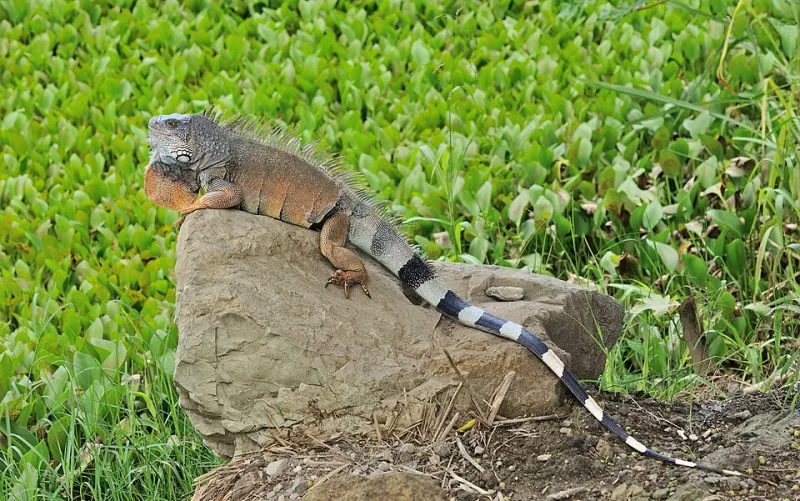
Photo: Cayambe, CC BY-SA 3.0, via Wikimedia Commons
Let us be blunt about something we say in exam rooms every week: the wildlife in your backyard is not a nature documentary. To your dog or cat, that iguana on the fence is a five-foot chew toy, and that toad by the sprinkler is something to grab with their mouth.
Both of those instincts can land your pet in our hospital.
The Iguana Situation Is Not Getting Better
If you've lived in Jupiter for more than a few years, you've watched the green iguana population go from 'occasional sighting' to 'they own the seawall.' Cold snaps knock the numbers down, and then they bounce right back. They sun themselves on docks, dig burrows under lanais, and raid gardens.
Here's the thing most owners miss: iguanas aren't venomous, but they're not harmless either.
The chase is the injury. A dog that corners an iguana is meeting a defensive animal armed with a whip-like tail, sharp claws, and rows of small serrated teeth. We've treated deep lacerations from tail whips across the face and eyes, bite wounds that look minor on the surface but damage tissue underneath, and punctures that get infected because iguana mouths — like all reptile mouths — carry bacteria.
Salmonella is real. Reptiles commonly carry it. A dog that mouths an iguana (or their droppings) can pick it up, and while adult dogs often shrug it off, puppies, seniors, and immunocompromised pets can get seriously ill. It can also spread to the humans in the house.
Parasites. Iguanas and other invasive reptiles host parasites like Pentastomids that can transfer to pets through contact or predation. Chronic vomiting or unexplained weight loss in a lizard-chaser is worth investigating, not dismissing.
Cane Toads: The One That Genuinely Scares Us
If you remember nothing else from this article, remember the Cane toad — also called the giant or bufo toad. They're large (up to 6 inches), warty, and they sit in puddles, pet bowls, and around porch lights at night, which is exactly when and where dogs go nosing around.
Cane toads secrete a potent toxin from glands on their shoulders. When a dog bites or licks one, that toxin is absorbed through the gums fast — and it attacks the heart and nervous system.
Signs of Cane toad exposure:
- Profuse drooling and foaming at the mouth
- Pawing at the mouth, head shaking, gagging
- Bright red gums
- Vomiting
- Stumbling, tremors, seizures
- Irregular heartbeat
What to do in the first 60 seconds:
- Wipe the inside of the mouth with a damp cloth — sweep along the gums and tongue, from back to front, and rinse the cloth between wipes. Do NOT hose water down your dog's throat; you can force toxin-laden fluid into their lungs.
- Call your veterinarian immediately. Say the words 'possible toad exposure.'
- Get to the clinic. This is a race against the toxin, and time matters enormously.
Small dogs are at higher risk simply because the dose relative to their body size is bigger. But a large dog with a full mouthful of toad is in serious trouble too.
'But My Dog Just Watches Them'
This is the line that worries us, because we've met plenty of dogs who watched wildlife calmly — right up until the day they didn't. Prey drive doesn't announce itself. Cats, meanwhile, are stealth hunters by design; an indoor cat who slips onto a screened lanai with a toad nearby is exactly the scenario we dread.
Our honest opinion: if you live in Jupiter and your pet has access to a yard, lanai, or fence line, you should treat wildlife encounters as a when, not an if.
Making Your Yard Less Interesting
You can't iguana-proof South Florida, but you can lower the odds:
- Do a dusk and dawn patrol. Cane toads are most active at night, especially after rain. Flashlight check the yard before letting the dog out.
- Skip the pet food outdoors. Leftover kibble attracts toads. Feed pets inside, and don't leave bowls out overnight.
- Trim and tidy. Iguanas love dense brush, wood piles, and rock crevices. Toads love damp, shady hiding spots. Remove the real estate.
- Supervise water features. Ponds and fountains are toad magnets.
- Teach a rock-solid 'leave it.' It won't override prey drive in every dog, but it buys you the seconds that matter.
So When Do You Actually Call Us?
Immediately, no hesitation, if your pet:
- Had mouth contact with any toad
- Is bleeding from a wildlife encounter, especially around the face or eyes
- Is drooling, vomiting, tremoring, or wobbling after being outside
- Ate or mouthed reptile droppings and later seems off
For iguana sightings alone — no contact, no chase — you don't need a vet. You need a plan for next time.
Wildlife is part of the deal when you live somewhere this beautiful. But 'part of the deal' doesn't have to mean 'part of the emergency.' Save our number, know the toad protocol, and keep the flashlight by the back door. Your pet's curiosity isn't going anywhere — but with a little preparation, neither are they.