He's Not Just Getting Old: 5 Subtle Clues Your Dog Is Hurting
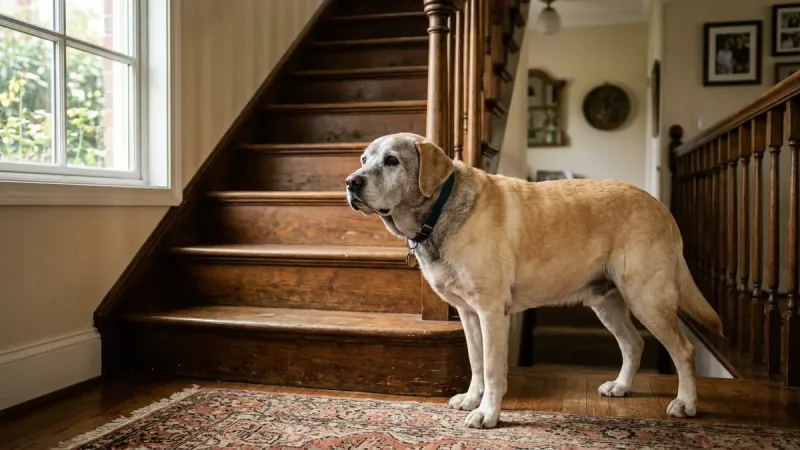
Photo: older dog hesitating on stairs subtle pain signs home, via images.webvet.com
Most dog owners have a mental image of what a painful dog looks like: holding a paw up, limping across the kitchen tile, maybe whimpering. And sure, that happens. But in our experience at Jupiter Veterinary Center, dogs are much more subtle than that. They're descendants of animals that survived by not advertising weakness, and that instinct hasn't gone anywhere.
So the limping-only mindset means a lot of dogs suffer quietly for months while their people say, 'Oh, that's just how he is.' Here are five signs we wish more owners took seriously.
1. The Stairs Have Become a Negotiation
If your dog used to bound upstairs after the kids and now waits at the bottom, hesitates at the first step, or takes the descent at a weird sideways angle — that's not stubbornness. Hesitation on stairs or jumping into the car is one of the earliest signals of joint pain, especially in the hips, knees, and elbows.
Watch for: pauses before movement, using the railing-side approach, or asking to be lifted where they never used to.
2. Excessive Lip Licking and Yawning (When Nobody's Eating)
Lip licking gets filed under 'cute' or 'he wants my sandwich,' but when it happens out of context — no food around, no training session — it's frequently a stress or pain signal. Dogs in discomfort often show these small, repetitive calming behaviors: lip licking, tongue flicking, yawning when they're not tired.
One instance means nothing. A pattern, especially paired with other changes on this list, means something.
3. Sleeping in Strange Positions — or Not Sleeping Well
Pain follows dogs to bed. A dog who used to sprawl belly-up but now curls into a tight ball may be protecting a sore back or belly. A dog who keeps a favorite side, or who gets up stiff and repositions constantly overnight, is telling you something about how their body feels at rest.
Cats do this too, by the way — a cat who stops sleeping curled up and starts sitting 'loafed' with a hunched back deserves a closer look.
4. The Sudden Grump Era
This one's tough for families to accept: the dog who growled when the toddler crawled near her yesterday wasn't 'being difficult.' New irritability — snapping when touched, avoiding being petted, growling at familiar people or dogs — is one of the most common pain indicators we see, and one of the most commonly misread.
A behavior change with no obvious trigger warrants a pain check before a behaviorist. Fix the pain, and the 'attitude problem' often disappears.
5. 'He's Just Slowing Down'
We hear this phrase every week, and it's the one that concerns us most. Age changes a dog's muzzle color; pain changes a dog's pace. Slower walks, shorter play sessions, less interest in the fetch ball, refusing the morning jog — these are frequently arthritis, not just 'getting older.'
Here's the good news: arthritis and age-related joint pain are among the most treatable conditions we manage. Between modern pain medications, joint supplements, weight management, and therapies, 'slowing down' is not a sentence your dog has to accept.
Book the Appointment or Watch at Home?
A reasonable middle path: if you've noticed one mild sign for less than a few days and your dog is otherwise eating, drinking, and moving normally, it's fine to monitor closely and note patterns. But call us promptly if:
- Signs last more than a few days or are getting worse
- Your dog is vocalizing, panting at rest, or refusing food
- There's any limping, swelling, or crying when touched
- Behavior changes are sudden or severe (growling at family members counts)
- Your gut says something's off — that instinct is usually right
There's no trophy for waiting. The dogs who do best long-term are the ones whose people noticed early and asked. If any of these five quirks sound familiar, give us a call — your dog would thank you if he weren't busy pretending everything's fine.